
The production of handmade sculptures and the use of tools
and equipment in manufacturing.
A key advantage of working by hand is the sense of naturalness it imparts to the work. The traces left from hand-modeling, carving, scraping, cutting, or polishing create a diverse surface texture that avoids being overly flat or uniform. These slight imperfections actually give the sculpture life, emotion, and effectively reflect the creator’s unique personality. Particularly for pieces aimed at conveying feeling, movement, or humanity, the mark of the hand carries immense artistic value, allowing viewers to truly sense the human creative process behind the piece.
Furthermore, working by hand offers artists the flexibility to alter details at any point during the process. If a form feels off mid-process, the artist can immediately adjust, add, or deduct elements, making it ideal for work centered on experimentation and exploring new forms. However, the drawback of manual production is that it is quite time-consuming, especially for large-scale works or those with intricate details. Additionally, the quality of the final piece relies heavily on the artisan’s skill and experience; a lack of expertise can lead to errors or inconsistency in the final shape.
Conversely, incorporating power tools and machinery into the production process significantly boosts efficiency. Tools such as grinders, polishers, saws, lathes, or trimming equipment help reduce both time and physical labor during material shaping—particularly with hard materials like stone, wood, or metal. Using these implements enables artists to manage large volumes of material faster and execute large-scale or complex geometric forms without demanding as much physical exertion as fully manual methods.
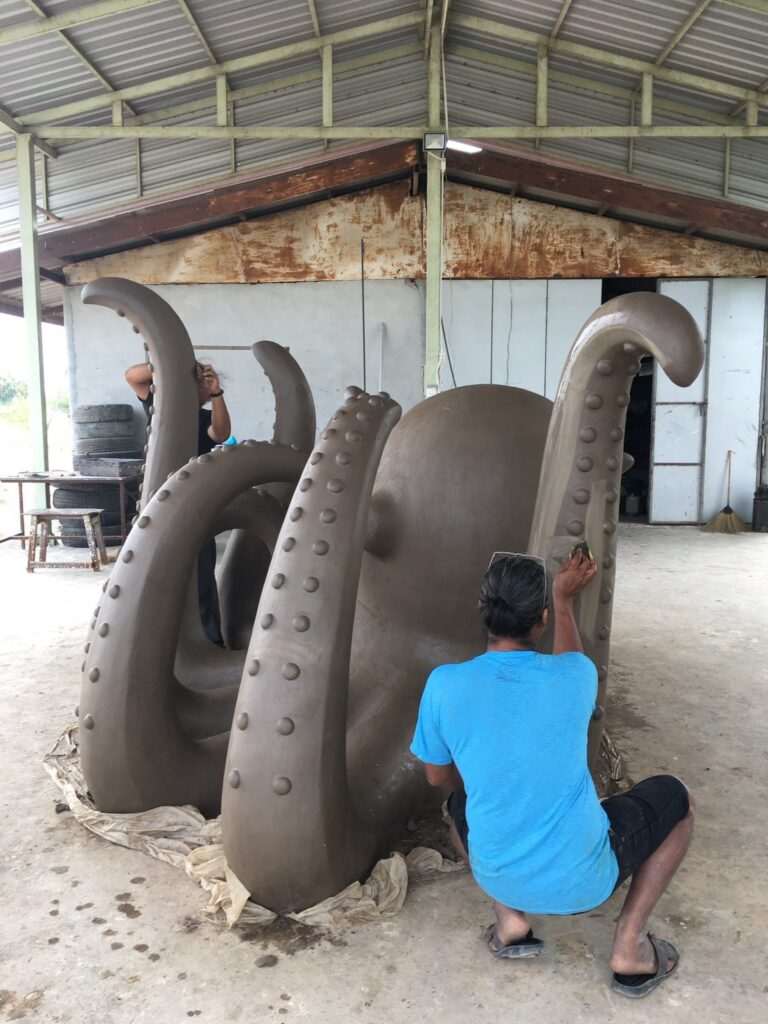
Another key advantage of using machinery is precision and consistency. Machines operate according to specified dimensions and patterns, allowing for exact control over proportions and forms. This is particularly crucial for work requiring high accuracy, such as architectural sculptural components, mass-produced pieces, or highly uniform geometric shapes. Modern technologies—such as 3D computer-aided design and CNC machinery—further empower artists to construct prototypes and translate digital models into actual production with high efficiency.
However, machine use comes with limitations. Overemphasizing speed and accuracy can result in surface textures that feel so smooth and uniform that they lose their natural character. The resulting forms may appear technically perfect, yet lack the organic marks of the creative process. Furthermore, machinery incurs significant purchasing and maintenance costs and requires technical operational knowledge. Without proper understanding of the equipment, operators risk damaging materials or tools, or even causing personal injury.
Consequently, contemporary sculpture production does not require a strict binary choice between “handcrafted” and “machine-made.” Instead, artists can synthesize the strengths of both approaches. This hybrid method leverages machinery for stages requiring speed and structural efficiency, followed by manual hand-finishing to refine subtle details and restore a natural, tactile quality. This balanced workflow bridges technological efficiency with the artistic value inherent in human craftsmanship.

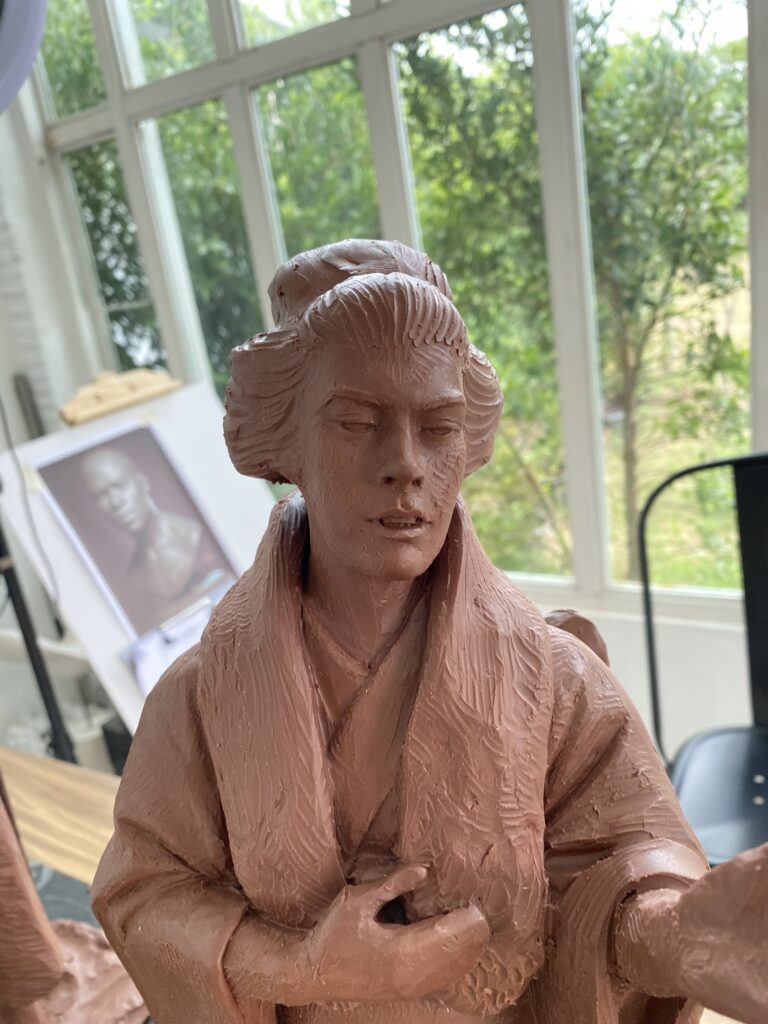
In the initial stage, machinery can be used for material preparation and primary shaping, such as cutting materials to size, removing excess mass, roughing out basic forms, or fabricating precise structures. Utilizing tools during this phase significantly cuts down work time and reduces physical exertion. Once the material closely mirrors the desired form, the artist steps in for the manual finishing process—a crucial step in bringing the artwork to full completion.
Hand-finishing can take various forms depending on the chosen material and artistic concept. Techniques include using fine chisels to capture subtle details, sanding or buffing surfaces with abrasive tools, refining lines, contours, and surface rhythms, as well as leaving subtle hand marks. This stage goes beyond merely correcting machine artifacts; it serves as a creative conduit through which the artist infuses their personal touch, emotion, and identity into the sculpture.
The contrast between machine-machined surfaces and handcrafted textures fundamentally shapes the viewer’s perception. Machine-rendered surfaces tend to be uniform and systematic, whereas hand-finished surfaces express variations in pressure, force, and stroke direction. When these two qualities are thoughtfully integrated, the final piece strikes a balance between technical precision and organic naturalness. Machines function as tools to boost speed and structural efficiency, while the artist’s hands deliver nuanced detail, raw emotion, and a distinct artistic identity.
Consequently, the key advantage of a hybrid approach lies in leveraging technology to save time without sacrificing the value of handcrafted artistry. Artists can reduce the time spent on labor-intensive, repetitive tasks, freeing up their time and mental energy for conceptualizing, analyzing, and crafting the details that carry greater artistic significance. Furthermore, this method is particularly well-suited for large-scale sculptures which, if created entirely by hand, would demand substantial time and physical effort. At the same time, manual hand-finishing helps soften rigid or overly industrial aesthetics, preserving a sense of warmth and human touch within the artwork.
On the downside, a hybrid workflow demands a dual proficiency in technical skills and artistic craftsmanship. Creators must understand how to operate machinery while simultaneously mastering hand-refinement techniques. If the machine-shaping phase and the finishing phase are poorly integrated, it can result in unintended textural mismatches or structural flaws. Additionally, certain types of tools and machinery carry high costs, require dedicated workspace, and necessitate proper safety protocols, making them less accessible for artists or studios with limited resources.
From an artistic standpoint, handcrafting retains a clear advantage in terms of distinct identity and naturalness, as every movement of the artist’s hand directly impacts the final form. Conversely, machinery excels in speed, precision, and the capacity for large-scale or high-volume production. Ultimately, neither method is universally superior to the other; the optimal choice depends on the nature of the project, material, core concept, budget, timeline, and desired artistic outcome.
Summary
In summary, the integration of tools and equipment in sculpture production marks a significant advancement that enhances the capability of artists and fabricators, enabling the efficient creation of larger and more complex works. At the same time, handcrafted production retains its vital role as the source of natural texture, emotion, and distinct identity, particularly during the finishing stage—where artists leverage their skill and experience to refine details and surfaces.
Therefore, the optimal approach to contemporary sculpture production is not a strict choice between machinery or pure handwork, but rather knowing how to select the right tool for each specific phase of creation. Machinery serves to save time and reduce labor during heavy, repetitive, or primary shaping tasks, while manual craftsmanship steps in to infuse subtle details and emotional resonance in the final stage. Synthesizing both methods yields artwork that unites technological precision with organic, human beauty—demonstrating that technology does not replace the artist, but rather serves as a tool that broadens the horizons of artistic creation.